One Small Thing: How to cure lack of motivation

A journey of a thousand miles begins with one step.
--Lao-tzu
Sometimes when inspiration and motivation are lacking, all it takes is doing one small thing to get you back on the right track.
Projects often seem huge and overwhelming when viewed as a whole. So, you say you want to draw every day? Your brain whizzes forward an imagines 365 completed and fantastic pencil or ink drawings. There is no way you could achieve all that in one day, let alone one week.
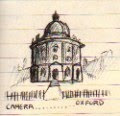
Rather, start small. I was in Oxford the other day and knew that I would be too tired to complete a large drawing when I returned home. Instead, I whipped out my ballpoint pen and did a tiny sketch in my day planner. This sketch of the Radcliffe Camera in Oxford is no more than 1.5 cm square. But that is big enough to count as a drawing.
So, for whatever project or job you have looming over your head, just identify one small thing you can do right now to get started. Send that email, file those papers, dust your desk.
That small step you just took will lead you on an epic journey towards your highest potential.
Don't worry. Everything is going to be amazing.
It was one of those days when I woke up and wished I could go straight back to bed. Working as a freelance illustrator means that my days are largely self-motivated. If I don't get something done, I'm the only person I have to answer to (aside from the occasional deadline). And... speaking of deadlines, I love them, because then it means that I'm needed! But this also means that I am often too hard to myself. I probably speak more harshly to myself, and more critically, than any manager, editor or boss would. Sometimes I need to remind myself to enjoy the moment, and remember that I'm doing what I love.
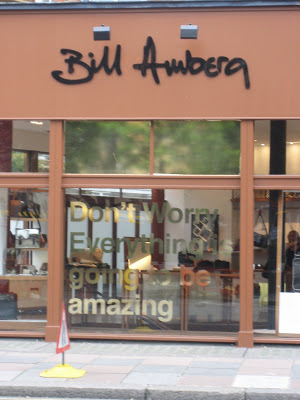
So, I went for a walk in the (almost) rain to clear my head and attempt some ambulatory encouragement. Low and behold, the universe sent me the sign I needed. At the corner of Westbourne Grove and Chepstow Villas in Notting Hill I saw a shop window whose sign read, "Don't worry. Everything is going to be amazing."
I suppose I have to take the universe at its word, and believe that it is true. Wasn't it Deepak Chopra who said, "...pay attention: nothing is random, your life is full of signs and symbols."
I haven't posted much artwork lately, mostly because my current illustrations are of the boring variety (more Roman pottery, anyone?). However, I have been turning a little bit of spare time to working on one of my book dummy ideas. I had shelved the sketches for "One, Two, Buckle my Shoe" several months ago because I couldn't see where they should go. But, now I have a little more clarity.
And remember. DON'T WORRY: Everything is going to be amazing!
Designing a creative CV
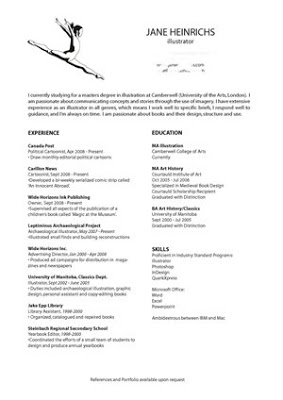
Writing a successful CV for the creative industries is different from most other industries. A well-designed CV is the first impression a future employer will get of you, your style, and your methods of working. It is your first opportunity to market yourself.
This blog post is not about the content of your CV, as there are a plethora of internet articles about what to include (personal details, education, work experience, hobbies, references, power words, etc). Rather, this article is about creative design and how to tailor your CV to your own particular style.
Branding is one of the strongest propaganda and marketing tools available. A well branded CV is the first taste of your style an employer will receive, and you need to convince him or her that seeing the rest of your portfolio would be worthwhile. A branded CV creates an image of value.
How to design your CV
There is no universal blueprint for how to design your CV, as it must be very personal to your industry, your skills and your goals. However, a successful CV will always have the following qualities:
- has visual impact to attract employers attention
- reflects your personality and strengths
- fits the industry, organization, and job requirements your are targeting
- demonstrates that you have the required skills
Employers in different industries will be looking for different types of presentation and content. You may need to change the content of your CV for every job you apply to, as it is important to design your CV with a specific employer in mind.
Layout and Design
The layout of your CV is as important as the contents in the creative world. If it doesn't grab your potential employers attention immediately, it may not be read at all. You are telling a visual story of why an employer should hire you and giving them a first glimpse of your portfolio. Pull out the stops and use all your talents!
Type:
You should use layout and typography to make sure the contents are easy to follow and lead the reader's eyes directly to the most important points. To do this you can play with size of type, colour of type and spacing. Be consistent with your font styling. If certain headings or skills are emphasized in bold, for example, the reader will expect all important things to be consistently highlighted.
Images:
You may want to highlight your creativity and innovation by including images in the design of your CV. If you integrate them well, they will make your CV stand out and instantly show the employer your skill and abilities. If you do this, you need to ensure the visuals compliment the overall look of the CV.
Length:
Your CV shouldn't be more than two pages. If it is, make sure it is only one page double-sided and that you put the most important information on the first page. Place the various sections in an order that will highlight your strengths.
Make sure it photocopies well, and is easy to email.
Examples of creative CVs
To see examples of award winning CV design, click
Search Posts
Archive
Featured Posts
-
February 2024
- Feb 25, 2024 February Sketchbook Feb 25, 2024
- Feb 1, 2024 January Sketchbook 2024 Feb 1, 2024